
Resource · Guide
Who pays for painting at the end of a lease in Geneva: tenant or landlord?
At the end of a lease, the same question comes up on both sides: who pays for the painting, the tenant or the landlord? The property manager wants a fair, solid move-out statement. The tenant wants to pay their fair share, no more, no less. Geneva's legal framework gives both parties clear markers, provided you read them calmly. Renovhome works for property managers and private clients alike, with a neutral technical assessment and a clear breakdown of costs.
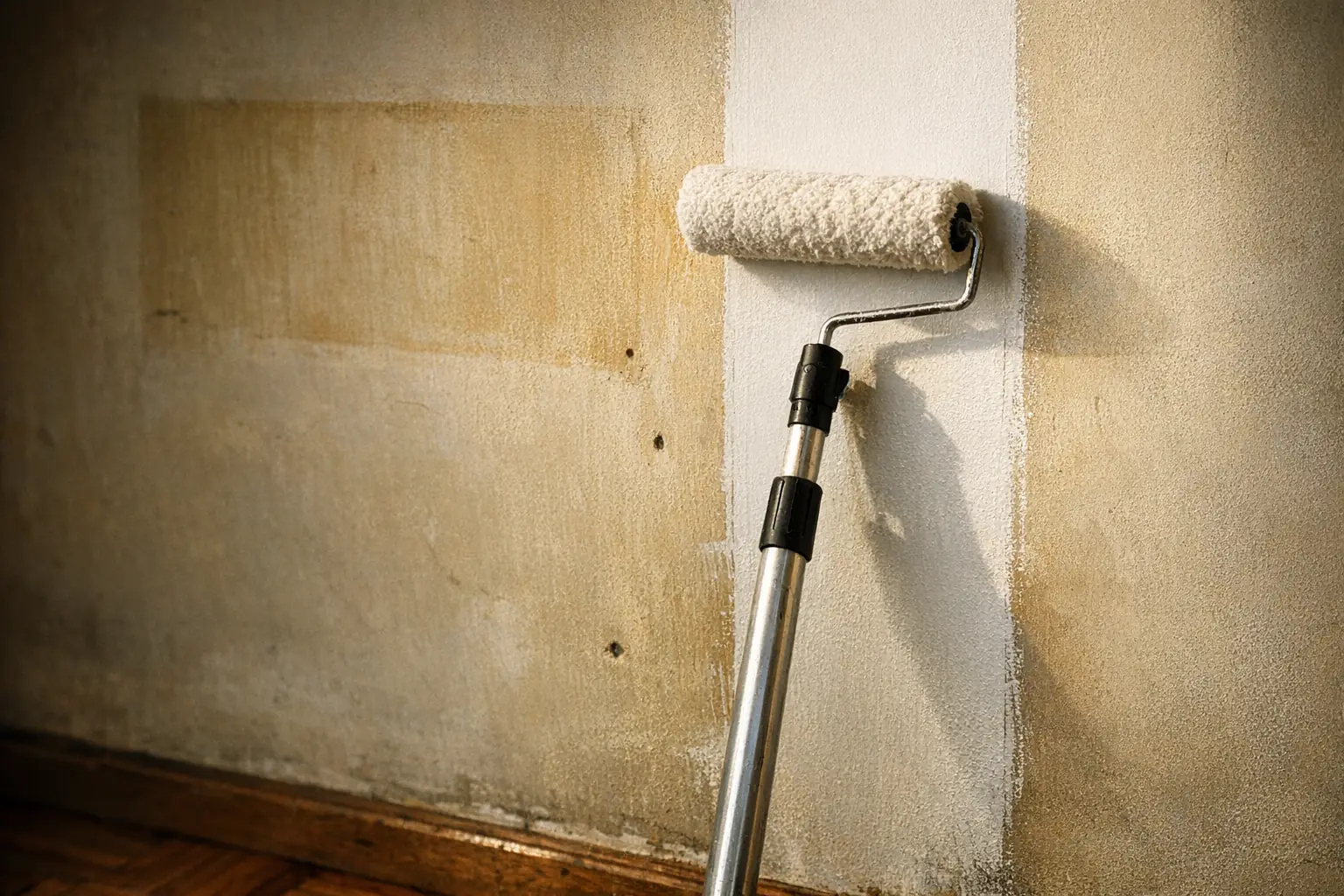
An empty flat in Geneva, a morning at the end of a lease. The light skims the walls and reveals every furniture mark, every small plug hole. On site, one question fills the room: who pays for the painting, the tenant or the landlord?
The answer is neither “all on the tenant” nor “all on the landlord”. It is read case by case, with the lease and the move-in inventory. Here are the markers, explained simply, useful to property manager and tenant alike.
Who has to repaint, tenant or landlord? The principle in one sentence
The starting point comes down to one idea. At the end of the lease, the tenant returns the home “in the state resulting from use in accordance with the contract” (Art. 267 para. 1 CO).
In other words: a home used normally, not a refurbished one. The tenant does not have to erase the passage of time.
What counts as normal use stays with the landlord. What exceeds normal use may be charged to the tenant. The whole question of the statement turns on that line.
To read it correctly, two documents matter most: the lease and the move-in inventory. The latter, dated and signed, serves as the central proof in any dispute.
Normal wear and tear in a flat in Switzerland: what the rent already covers
Rent does not only pay for occupying the place. It is deemed to cover the upkeep linked to normal use. Ordinary ageing is therefore part of what the landlord bears.
A few examples speak for themselves. Furniture marks on the walls are normal wear. Paint that dulls over the years, too.
Conversely, some damage clearly exceeds that use. Heavily blackened walls, wallpaper scribbled on by children, a torn-off handle: there, the tenant answers for the damage.
The logic is easy to remember. Time passing is for the landlord. Real damage is for the tenant.
The eight-year rule and the residual-value calculation
When the tenant answers for damage, they never pay the price of new. They pay the residual value — the share of life the covering had left.
The calculation is clear: cost × (remaining lifespan ÷ total lifespan). Wallpaper rated for ten years, damaged after seven, is reimbursed at 30%.
These lifespans appear in the Joint Depreciation Table, drawn up by the Fédération romande immobilière and ASLOCA, and recognised by the USPI. Its own text states that it has “no binding force”. It is an indicative marker, yet courts and conciliation authorities refer to it routinely.
Here are the most useful indicative lifespans:
| Covering | Indicative lifespan |
|---|---|
| Dispersion paint (walls and ceilings, usual case) | 8 years |
| Alkyd or synthetic resin | 15 years |
| Medium-quality wallpaper | 10 years |
| Oil/synthetic paint on doors and door frames | 20 years |
| Oil/enamel on window frames and sills | 10 years |
The consequence matters for the statement. Once the lifespan has elapsed, the residual value is nil. Dispersion paint more than eight years old gives rise, in principle, to no charge, even if the wall is marked.
To place each case, this second table helps:
| Situation | Whose responsibility |
|---|---|
| Furniture marks, paint that ages | Landlord (normal wear) |
| Dispersion paint over 8 years old, even damaged | Landlord (residual value nil) |
| Real damage before the end of the lifespan | Tenant, at residual value |
| Colour applied without written consent | Tenant (return to original shade) |
| Shutters, external faces of frames | Landlord (envelope, Art. 256 CO) |
Read with your lease and your move-in inventory: every home has its own history.
A move-out statement that holds: for the property manager and the tenant alike
A good statement is not a “hard” statement. It is a well-founded one. Calculated at residual value and notified in time, it stands before the conciliation authority. That serves the property manager as much as the tenant.
First point: no flat rate. A clause imposing a repainting indemnity in advance, with no real damage, is void (Art. 267 para. 2 CO). Only established damage is billed.
Second point: deadlines matter for everyone. On return, the landlord must inspect the property and immediately notify the tenant of defects (Art. 267a CO). In practice, two to three working days; ASLOCA Geneva considers a week already late. The Federal Supreme Court held notice given more than two months later to be late (judgment 4A_388/2013), with the loss of the right to claim. Inspecting and notifying quickly is therefore good property-manager practice.
Third point: the rent deposit. It does not exceed three months’ rent and stays in an account in the tenant’s name (Art. 257e CO). It is released with both parties’ written agreement, a judgment or an unopposed payment order.
For a statement that holds: three reflexes
- A dated assessment, made soon after the return.
- Each item priced at residual value, not the price of new.
- The move-in inventory to hand, to compare before and after.
The cases that tip towards the tenant: colour, nicotine, holes
Some situations change things and can engage the tenant. Best to know them on both sides.
Colour first. Repainting walls in colour is a modification requiring the landlord’s written consent (Art. 260a CO). Without agreement, the tenant returns the original shade at their own cost before leaving. If the landlord consented in writing without reserving reinstatement, they can in principle no longer require it.
Nicotine next. Walls yellowed by smoke are treated in practice as excessive wear. The treatment, with an anti-nicotine primer, can then be charged to the tenant.
Plug holes last. In reasonable number and neatly filled, sanded and without any mark, they are normal use. ASLOCA Geneva sums it up: you “fill the holes but without repainting”. No text sets a permitted number of holes, so be wary of the figures that circulate.
For woodwork, the choice of finish matters too. The enamel of woodwork is not treated like wall dispersion, neither in lifespan nor in look.
On between-tenancy jobs, the same breakdown logic applies. We explain it in detail in repairs between tenants: who pays for what.
For property managers, Renovhome provides a reliable technical assessment and a clear breakdown of costs: upkeep on the landlord, share chargeable to the tenant, any insurance claim. That is what makes a statement readable and defensible. Discover our support for property managers in Geneva, or simply request a detailed quote.
André Brito Lobo, painter — Renovhome SA, Geneva For an assessment and a detailed quote that clarify your move-out statement: request a free quote.
Frequently asked questions
Key takeaways, in brief.
Who repaints the shutters, tenant or landlord?
Shutters and the external faces of window frames are part of the building envelope. Their upkeep is in principle the landlord's responsibility (Art. 256 CO), as the party who must keep the let property in good condition. The tenant therefore does not repaint the shutters when leaving, unless they caused specific damage exceeding normal use. Inside, by contrast, each case is read room by room, with the lease and the move-in inventory.
Does the tenant have to repaint before leaving?
No, not as a matter of principle. The tenant returns the home in the state resulting from use in accordance with the contract (Art. 267 para. 1 CO), not freshly repainted. Normal wear linked to time and careful use stays with the landlord. The tenant only has to repaint where they caused damage exceeding normal use, or where they applied a colour without the landlord's written consent.
Who repaints the front door?
Oil or synthetic paint on doors and door frames has an indicative lifespan of twenty years under the Joint Depreciation Table. As long as that period has not elapsed and no damage exceeds normal use, the tenant has nothing to repaint. If they genuinely damaged the door, their share is calculated at the residual value, taking the age of the paint into account.
If the paint is more than eight years old, does the tenant still pay for damage?
For dispersion paint on walls and ceilings, the indicative lifespan is eight years. Beyond that, the residual value is in principle nil. The tenant then owes nothing for that paint, even if the wall is damaged, because the lifespan had already elapsed. Before eight years, their share is calculated pro rata to the remaining years.
Can the property manager withhold the rent deposit for painting?
The rent deposit does not exceed three months' rent and stays in an account in the tenant's name (Art. 257e CO). It is released with both parties' written agreement, a court judgment or an unopposed payment order. The property manager therefore cannot keep it alone on its own decision. One year after the end of the lease, with no debt-collection or claim, the tenant can demand it back.
Your project
Describe your project, receive your free quote.
A few lines are enough to get started. We call you back quickly, then you receive your free quote. A dedicated point of contact who follows your project, from measurements to handover.
Rated 5,0 out of 5 · 13 Google reviews · A free, written, detailed quote. Quick reply. Your data protected (Swiss Data Protection Act).