
Resource · Guide
Move-out inventory in Geneva: paint, normal wear or damage?
Last updated:
The move-out inventory is the moment when every wall is examined up close, in raking light. Flaking paint by a window, a ceiling yellowed above the radiator, plug holes in the living room: what can be held against you, and what does the rent already cover? In Geneva, the answer comes down to a simple line between normal wear and genuine damage — and to deadlines that protect both parties. Renovhome works for property managers and tenants alike, with a neutral technical assessment.
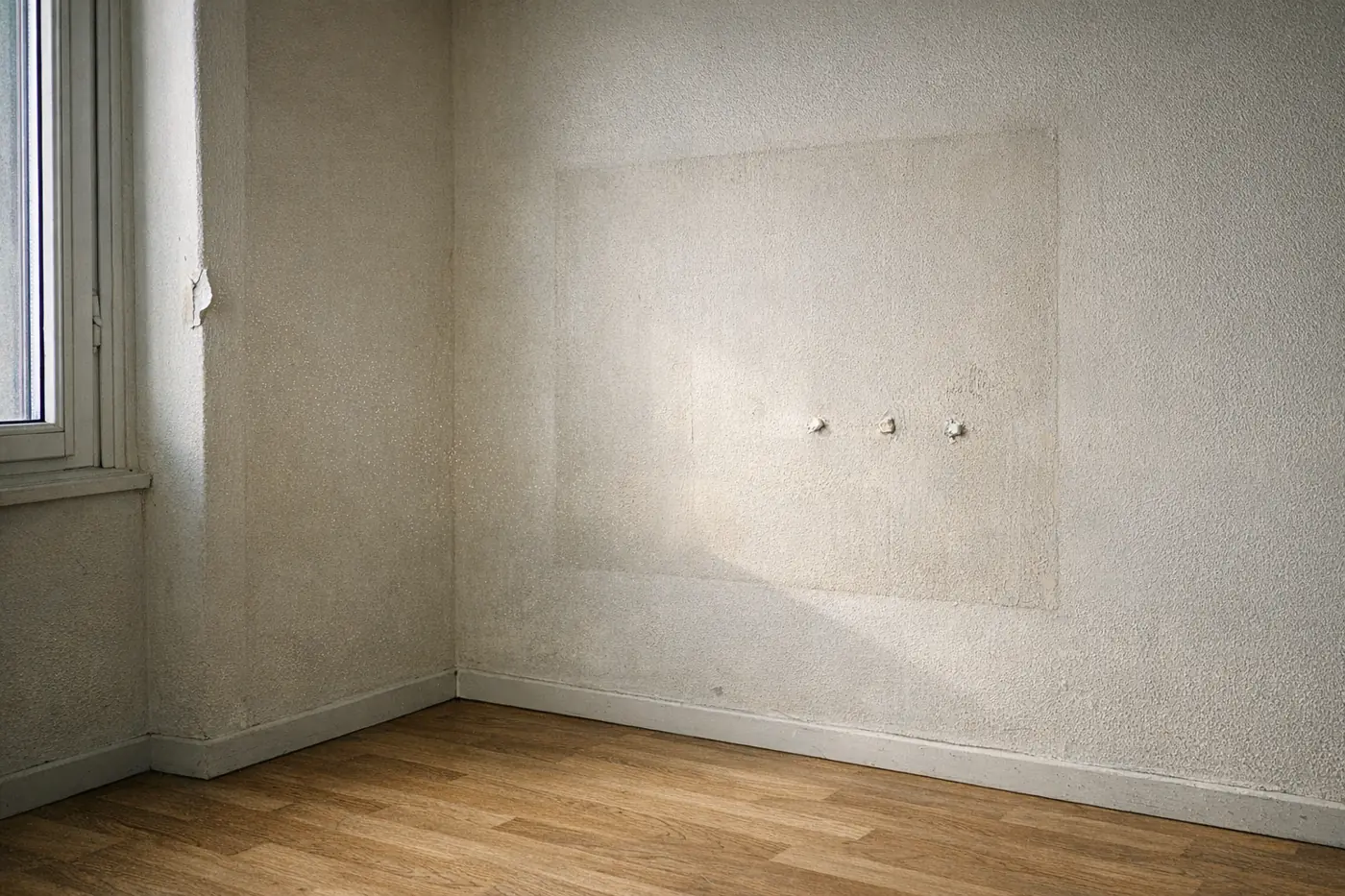
A Monday morning, an empty three-room flat in Geneva. The manager opens the shutters, the light skims the walls and brings out what you stopped noticing while living there: the lighter rectangle of a wardrobe, a small flake near the window, three plug holes in the living room. The whole point of the move-out inventory is right there — deciding, wall by wall, what belongs to the passing of time and what falls to you.
The good news: the dividing line is clearer than people think, and it works both ways. Here is how an inventory reads on the paint side, defect by defect, with the deadlines that matter.
How a move-out inventory reads
At move-out, paint is not judged in the abstract. It is compared to its starting point: the move-in inventory. That is the reference document, the one that says the state you received the home in.
The move-out report, dated and signed by both parties, then serves as proof. If it lists defects clearly, it can even count as notice of defects. But mind one point that is often overlooked: you are never obliged to sign a report whose content you dispute. You can note your reservations, or refuse to sign.
The principle that governs everything is simple. On leaving, the tenant returns the home “in the state resulting from use in accordance with the contract” (Art. 267 para. 1 CO): a home used normally, not a refurbished one. And without a written move-in inventory, it is up to the landlord to prove a defect did not exist when you arrived.
One thing many people discover too late: the deadlines. On return, the landlord must check the condition and report defects immediately (Art. 267a CO). In practice, that means two to three working days; ASLOCA Geneva considers one week already late. The Federal Supreme Court found a notice given more than two months after the handover of keys to be late (ruling 4A_388/2013), with the loss of the right to claim as a result. Assessing and notifying quickly is therefore in everyone’s interest: a solid statement for the property manager, a clear framework for the tenant.
Flaking or blistering paint: wear of time or damage?
This is the most common case, and the most misunderstood. Paint flakes or blisters for many reasons that have nothing to do with the tenant: it has simply served its time, the substrate was drawing a little damp, the previous coat gripped poorly. In those cases, it is wear — borne by the landlord.
Rent, after all, is deemed to cover the upkeep linked to normal use. The ordinary ageing of paint is part of that. A wall that dulls, a window reveal whose enamel crumbles over the years: no one has to “repair time”.
Flaking paint only shifts to the tenant if it comes from abnormal use: an impact, a piece of furniture dragged against the wall, a leak left unaddressed, a heavily blackened wall. The question to ask is not “is it damaged?” but “what damaged it?”. Time, or rough use.
Yellowed paint: the sun, time… or smoke
A ceiling turning yellow, a wall greying above a radiator: here again, time is the first suspect. Sunlight, heat, the oxidation of an old synthetic paint make things yellow without anyone being at fault. That kind of yellowing is normal wear, borne by the landlord.
One exception comes up often, and it is nuanced: cigarettes. Walls and ceilings yellowed by smoke are treated by practice as excessive wear, because nicotine residues require extra work — an insulating anti-nicotine primer coat, costlier than a simple repaint. According to prevailing practice, that extra cost may be charged to the smoking tenant. Smoking at home remains lawful; it is the extent of the yellowing that tips it into excessive wear, assessed case by case.
Paint to be redone: who pays, and until when
When the inventory concludes that paint is “to be redone” and genuine damage justifies it, one rule is worth its weight in gold: the tenant never pays the price of new. They pay the residual value — the share of life the covering had left, calculated by its age.
These lifespans appear in the Joint Depreciation Table, drawn up by the Fédération romande immobilière and ASLOCA. Its own text states that it has “no binding force”. It is an indicative marker, yet courts and conciliation authorities refer to it routinely. For dispersion paint on walls and ceilings, the indicative lifespan is 8 years. Beyond that, the residual value is in principle nil: the paint is written off, and the tenant owes nothing for the repaint, even if the wall is marked.
Here is how what an inventory reveals on the paint side usually falls out:
| What the wall shows | Whose responsibility, most often |
|---|---|
| Paint that dulls or yellows over time | Landlord (normal wear) |
| Furniture marks, a lighter rectangle | Landlord (normal wear) |
| Dispersion paint over 8 years old, even marked | Landlord (residual value nil) |
| Impact, indelible stain, heavily blackened wall | Tenant, at the residual value |
| Walls yellowed by smoke | Tenant (excessive wear, anti-nicotine primer) |
| Colour applied without written consent | Tenant (return to original shade) |
Read this with your lease and your move-in inventory: every home has its own story.
The step-by-step calculation is set out in our article on who pays for painting at the end of a lease. Here, remember the logic above all: time is for the landlord, real damage is for the tenant, and always at the residual value.
Wear or damage? 4 checks in 2 minutes
- Was the defect already listed at move-in? Dig out the move-in inventory first.
- How old is the paint? For dispersion, keep the eight-year rule in mind.
- Was it time that did this, or rough use, a stain, an impact?
- Is the defect isolated or general? A whole wall ageing is often wear.
Plug holes: what passes, what does not
Hanging pictures, a shelf, a light fitting is part of a home’s normal life. Plug holes in reasonable number, properly filled and sanded, are therefore normal use. ASLOCA Geneva sums it up in a phrase: you fill the holes, but without repainting the walls.
What shifts is holes in excessive number, unfilled or crudely filled — filler that overspills, torn-out plugs, chips around the hole, fixings in an unsuitable substrate. There, a touch-up is due, calculated on the residual value of the paint. A proper fill leaves no visible line: you pack it, sand it, retouch it.
A word on a frequent search: the “scale” or “flat rate” for holes. It does not exist. No text or table sets a permitted number of holes. It is an assessment — “reasonable”, “not in excess” — not a per-unit count. Be wary of the numeric quotas you sometimes hear: they have no basis.
Did you repaint in a colour? Written consent changes everything
Repainting a wall in a personal shade is not a simple refresh: it is a modification of the home. And it requires the landlord’s written consent (Art. 260a CO).
In practice, two situations. Without written consent, the tenant returns the walls to their original shade — a white or a neutral tone — at their own expense before handing back the keys, failing which the repaint will be charged to them. But if the landlord gave written consent without reserving, in writing too, the return to the original state, they can in principle no longer require it on departure. Hence the useful reflex on both sides: anything to do with colour is settled in writing, at the time of the agreement.
The mistake we see every week Turning up at the move-out inventory without the move-in inventory. On both sides, that is where everything gets complicated: with no dated point of comparison, there is no way to say whether the flake or the stain was already there. The document often sleeps in a folder or an old mailbox. Your move-in inventory — do you know where it is? Find it before the appointment: it is the best protection, for tenant and property manager alike.
A move-out inventory that goes well is not a power struggle. It is a shared assessment, read calmly, with the right markers: wear on one side, damage on the other, residual value to put a figure on it, and deadlines kept. To prepare for that moment, our painting inventory checklist covers point by point what to look at; and repairs between tenants explains how costs are split between two leases.
For a neutral technical assessment and a clear breakdown — upkeep on the landlord, the share chargeable to the tenant, any water-damage claim — Renovhome works with property managers and tenants in Geneva alike.
The Renovhome team — Renovhome SA, Geneva To prepare for your inventory or assess a repaint before handing back the keys: request a free quote.
Frequently asked questions
Key takeaways, in brief.
Inventory and flaking paint: do I have to pay?
It depends on the cause. Paint that flakes or blisters because it has aged, or due to damp in the substrate, is normal wear and stays with the landlord. It only becomes damage chargeable to the tenant if it results from rough use or an accident. Even then, the tenant's share is calculated at the residual value: for dispersion paint, the indicative lifespan is 8 years.
Yellowed paint at the inventory, who pays?
Yellowing from time, sunlight or a radiator's heat is normal wear, borne by the landlord. Walls and ceilings yellowed by cigarette smoke, however, are treated by practice as excessive wear: the treatment, with an anti-nicotine sealing primer, may then be charged to the smoking tenant. The distinction is made case by case.
The inventory says 'paint to be redone': do I pay for new?
No, never the price of new. When a repaint is genuinely due to damage, the tenant only pays the residual value — the share of life the paint had left. For dispersion paint over 8 years old, that value is in principle nil: the tenant then owes nothing for the repaint, even if the wall is marked.
Is there a scale or a flat rate for holes at the inventory?
No, no text or table sets a permitted number of holes or a flat rate. Plug holes in reasonable number, properly filled and sanded, are normal use: according to ASLOCA Geneva, you fill the holes but do not repaint. Be wary of the numeric quotas that circulate: it is a matter of assessment, not a scale.
The paint is over 8 years old, is it still charged to me?
For dispersion paint on walls and ceilings, the indicative lifespan is 8 years. Beyond that, the residual value is in principle nil and the tenant owes nothing for the repaint, even in case of damage, because the paint was already written off. The lifespan appears in the Joint Depreciation Table, an indicative marker followed in practice by the conciliation authorities.
I disagree with the inventory, do I have to sign?
You are never obliged to sign a report whose content you dispute (ASLOCA Geneva). You can note your reservations or refuse to sign. Remember too that the landlord must report defects immediately (Art. 267a CO): if they wait too long, the tenant is released from any liability for those defects.
Guide published by Renovhome SA, painting company in Geneva — interior painting, ceilings, enamel finishes and between-tenancy repaints in every commune of the canton. One dedicated contact — ask your painter in Geneva for a free quote.
Your project
Describe your project, receive your free quote.
A few lines are enough to get started. We call you back quickly, then you receive your free quote. A dedicated point of contact who follows your project, from measurements to handover.
Rated 5,0 out of 5 · 20 Google reviews · A free, written, detailed quote. Quick reply. Your data protected (Swiss Data Protection Act).