
Enamel finishes — for surfaces that see wear.
Bathrooms, kitchens, interior doors, skirting boards. Enamel calls for surface preparation and cross-laid application — Renovhome SA's quote sets out the steps.
2-year legal warranty (Art. 371 CO) · Member of the GGE
Why enamel rather than acrylic?
Not every surface needs the same paint. Substrates exposed to moisture, frequent washing or knocks need a specific finish: that is the job of enamel.
- Moisture resistance — suited to bathrooms, kitchens and utility rooms.
- Washable — copes better with regular cleaning.
- Lasting performance — a finish designed for everyday use, more resistant than a matt paint.
- Appearance — satin or gloss, slightly brighter than a matt acrylic paint.
Surfaces we treat in enamel
- Wet-room walls — around the shower/bath, the worktop wall, kitchen splashback, utility room.
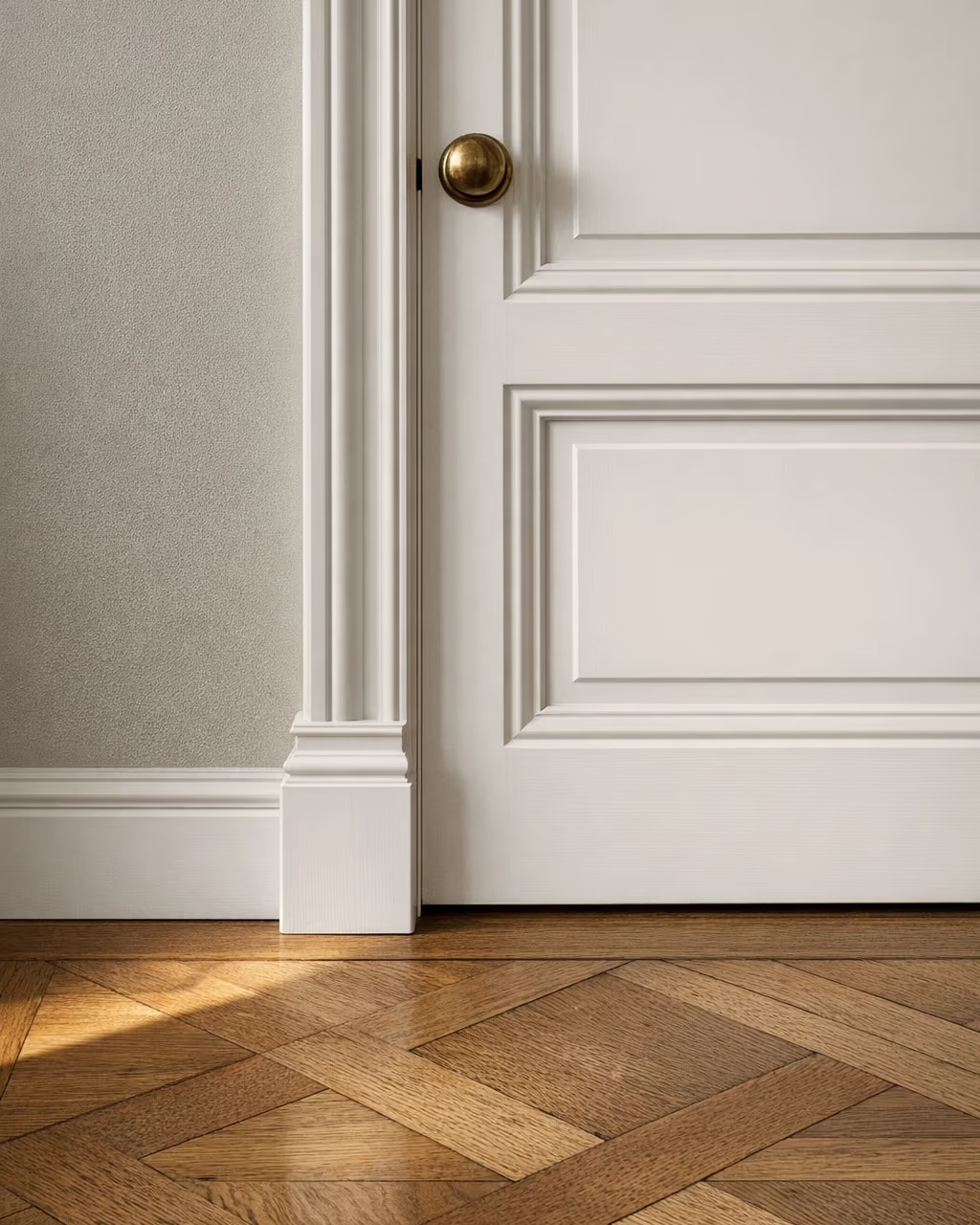
- Interior doors — flat entrance door, room doors, cupboard doors.
- Frames and architraves — increased resistance to traffic and contact.
- Skirting boards — cope better with floor washing.
- Built-in furniture — wall shelving, radiator casings, kitchen units.
Application calls for a precise protocol
- Degreasing the surfaces — enamel will not hold on a greasy substrate.
- Light sanding to open up the porosity of the substrate.
- Primer matched to the surface (wood, metal, existing enamel), where it is needed.
- Roller-applied enamel or a flat brush depending on the surface — in cross-laid coats, generally two; the quote sets it out.
- Drying and de-nibbing between coats.
- Final coat, then a final check before the end of the job.
Enamel leaves no room for improvisation: too thick a coat runs, too thin a coat fails to cover, and a poorly prepared substrate causes the paint to peel. It is a craft within the craft, hence the time spent on preparation.
What drives the duration of an enamel job?
Enamel sets its own pace: each coat must dry before de-nibbing and the next coat — it is the drying time between coats, not surface area alone, that paces the job. The number of faces to treat (doors, edges, architraves, built-in furniture) and the condition of the substrate do the rest. The duration is estimated with you in the quote.
Bathroom and kitchen — where enamel is often the best fit
In Geneva, some rooms cope poorly with standard matt or velvet acrylic paint. When traces of mould, flaking, ingrained fingerprints or glossy patches from washing start to appear after a year or two, it is usually a sign that enamel would have suited the room better.
Typical cases seen across Geneva’s housing stock:
- Bathroom with no mechanical ventilation, or with inadequate ventilation — around the shower, the bath panel, the wall behind the basin. Ambient moisture condenses constantly on acrylic paint and makes it peel. A satin enamel is generally better suited.
- Kitchen open to the living room — the wall behind the worktop, the cooking splashback, the extractor wall. Grease spatter and condensation quickly wear down a matt paint.
- Utility room or technical space — moisture, spatter, mechanical contact. Enamel is often the best fit here.
- High-traffic hallway — where walls are regularly rubbed (pushchairs, dogs, suitcases), a satin enamel on the lower section, up to the first 1.20 m, allows for regular washing.
Enamel — which level of sheen to choose?
Enamel comes in three main finishes that Renovhome SA can apply depending on the room and the effect sought:
- Matt enamel — discreet, with little reflection. Suited to living spaces where you want the durability of enamel without the sheen. It calls for very careful application, as flaws show up more than on satin.
- Satin enamel — the most versatile finish, slightly reflective, washable, and better at masking minor substrate defects. It is the standard choice for bathrooms, kitchens, skirting boards and doors.
- Gloss enamel — highly reflective, a high-gloss effect (entrance door, built-in furniture). It calls for very careful substrate preparation — the slightest irregularity shows. It also calls for application free of runs, which takes real skill.
The advantages of enamel over acrylic
| Criterion | Matt acrylic | Satin enamel |
|---|---|---|
| Moisture resistance | Low | Excellent |
| Washability | Limited (matt paint degraded by regular washing) | Excellent, can be washed regularly |
| Lasting performance | Adequate in a dry room | More resistant, even in a wet or high-traffic room |
| Appearance | Deep matt, little reflection | Slightly reflective, “silky” |
| Application difficulty | Standard | Calls for specific skill |
Enamel and wet rooms after a claim
If the room has suffered water damage, enamel alone is not enough. Our water-damage repair approach includes, where needed, a stain-blocking coat before the final enamel paint. This step limits the risk of water stains coming back through the finish.
A room that wears too quickly with acrylic paint? Enamel may be an answer; we look at it at the visit. Request your quote — Renovhome SA will get back to you to arrange a visit.
Content published by Renovhome SA, building painting company in Geneva since 2019. Your painter in Geneva for all your painting work.
Who it is for
