
Resource · Guide
Painting over wallpaper: when it works, and when to strip it off
Last updated:
A living room in Eaux-Vives, a Tuesday morning. On the wall, a slightly dated beige wallpaper: it lifts a little at a seam in one corner, but holds firm everywhere else. The question always comes the same way: "Can we paint over it, or do we have to tear it all off?" The answer depends less on the wallpaper itself than on one thing that is very quick to check. Here is how we decide, by eye and by hand.
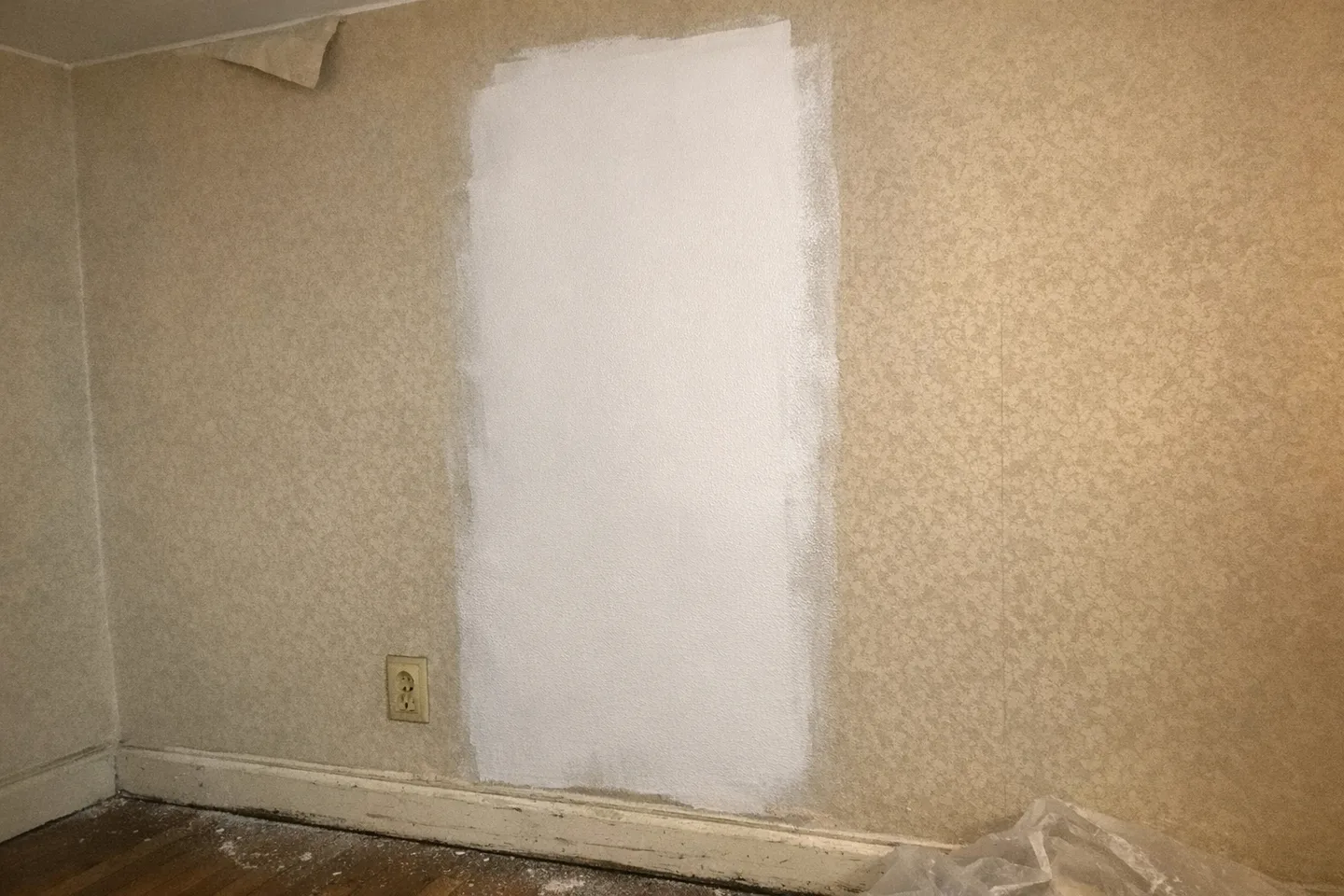
A living room in Eaux-Vives, a Tuesday morning. On the wall, a slightly dated beige wallpaper: it lifts a little at a seam in one corner, but holds firm everywhere else. The question always comes the same way: “Can we paint over it, or do we have to tear it all off?”
Often, you can paint. But it does not depend on how much you want to — it depends on one detail you check in thirty seconds, hand on the wall. Here are the markers, without jargon.
Can you paint over wallpaper? The only question that counts
Painting over wallpaper is possible on one condition: the paper must be perfectly stuck to the wall. Nothing else matters as much.
It is worth remembering, because it is quickly forgotten: paint never makes what is underneath hold better. A bit like varnish on a piece of furniture — it will never hold better than the wood it covers. If the paper lifts, the paint lifts with it, taking the corners and seams along.
The substrate must meet three words that every technical sheet repeats: clean, dry, load-bearing. A “load-bearing” substrate is one that adheres, that does not move, that you can build on. Well-stuck wallpaper, with no bubble and no open seam, is a load-bearing base. Wallpaper that bubbles is not.
Then it comes down to knowing which paper we are dealing with, because they do not all behave the same under the roller.
Painting over non-woven wallpaper: the easiest to cover
Non-woven paper is the easiest case. It is a fibrous, slightly thick paper, often hung as a “paint-ready” surface: many non-woven papers are even designed from the outset to take several coats of paint.
Its surface is absorbent, which helps paint grip. In most cases you can therefore paint the finish directly, without a special primer, after a simple dusting.
Two caveats, though. First, non-woven paper soaks it up: the first coat “drinks”, and you often need two coats of finish for an even result — which is the standard rule for an interior wall anyway. Second, a strong pattern or colour can show through: an opaque primer solves that before the finish.
Vinyl or washable wallpaper: the bonding primer changes everything
This is where trouble starts if you rush. A vinyl or washable paper has a plasticised surface, smooth and low-absorbency. A water-based paint grips it poorly: the roller slips, and as it dries the coat peels in patches.
The remedy is well known to painters: a bonding primer — a primer designed for smooth, weakly-absorbent substrates — before the finish. This kind of primer creates an adhering base where paint alone would not hold. Bonding primers sold in Switzerland are in fact intended to prepare these smooth substrates before paint or covering, and become overcoatable again after a few hours.
In practice, you sand the surface lightly to break the sheen, dust it off, apply the bonding primer, then the finish in one or two coats. Nothing complicated, but nothing to skip either.
A word of honesty: on vinyl in good condition, well stuck, the result is clean and lasting. On vinyl that ripples or whose seams open up, no primer will save the job. There, you remove it.
Painting over textured wallpaper: paint does not make it disappear
Many people hope it will, so let us say it plainly: painting over textured wallpaper (heavy grain, embossed pattern, structured glass fibre) does not flatten it. Paint follows the texture, it does not fill it. So you keep the texture — in a single, even colour, which is sometimes exactly the look you want.
If the texture is subtle, the result is pleasant and readily modern. If it is very pronounced or dated, painting it will only fix it under a neutral shade. When you want a truly smooth wall, there is no shortcut: you have to strip the paper, then skim the substrate with filler before painting. A step that calls for real preparation, as explained in our guide to preparing your home before the painter.
When it is better to strip than to paint
Painting over saves time, but it is not always the right call. There are cases where stripping first avoids a job that has to be redone six months later.
Is your wallpaper paintable? 4 checks in 2 minutes
- The seams. Run a fingernail along the strips: if they open or lift, the paper is not load-bearing.
- The bubbles. A flat palm on the wall: does it sound hollow, does it ripple? The paper has let go underneath.
- The layers. Two or three layers of paper stacked up? The whole thing is too heavy and unstable to take paint.
- Damp. A mark, a stain, a musty smell? Do not paint, and above all do not cover: find the cause.
That last point deserves a pause. On a damp or mould-affected wall, covering solves nothing: the problem comes back as long as the cause is untreated, even with a so-called “anti-mould” paint. That is the clear position of the Swiss health authorities. Treat the damp first, paint afterwards — the subject is detailed in our article on mould and damp on walls.
Here is how each situation reads at a glance:
| Type of wallpaper | Can you paint over it? | Key preparation |
|---|---|---|
| Well-stuck non-woven | Yes, the easiest case | Dust, 2 coats of finish |
| ”Paint-ready” paper | Yes, that is its purpose | Direct finish, primer if patterned |
| Vinyl / washable | Yes, with care | Sand + bonding primer |
| Textured paper | Yes, but the texture stays | Paint even, or strip + skim |
| Bubbling paper / open seams | No | Strip off, prepare the wall |
| Damp or mouldy substrate | No | Treat the cause first |
Adapt to your wall: when in doubt, a test on a small area decides better than a general rule.
When you decide to remove it, the method depends on the paper. Non-woven paper often comes off dry: lift a corner, pull the strip slowly, it comes away in one piece. A traditional paper, on the other hand, must be softened — warm water with a little stripping product, or a steam stripper — before running the scraper flat. The right reflex to strip without damaging the wall: never force, work strip by strip, and stay gentle on plasterboard, whose surface card tears easily.
Removing wallpaper at the end of a lease: what to know
The subject comes up often, on the tenant side as much as the property-manager side. In a rented flat, can you paint over the wallpaper or remove it?
In principle, changing the look of the walls is a modification of the home. It generally requires the written consent of the landlord (Art. 260a CO). Before painting over existing wallpaper or removing it, the safest move is to speak to the property manager and keep it in writing. It is the best way to avoid a dispute on the way out.
At the end of the lease, the home is returned “in the state resulting from use in accordance with the contract” (Art. 267 CO) — not necessarily refurbished, but in a state consistent with what was agreed. Each situation is assessed case by case, in connection with the lease and the check-in inventory. For the detail of what falls to the tenant and what stays with the landlord, we explain it in who pays for painting at the end of a lease in Geneva.
The mistake we see come back, every time: painting over wallpaper that was already lifting “to save time before the inventory inspection”. Three weeks later, the paint bubbles along with the paper, and the result is worse than the start — a wall to strip entirely instead of a simple touch-up. The time saved by skipping preparation is always paid back, and often double.
In practice: a good base before a fine wall
It all comes back to the same idea. Wallpaper can be an excellent base for paint — provided it holds, is clean and dry, and you match the preparation to its nature: nothing for a sound non-woven, a bonding primer for smooth vinyl, a full strip when it bubbles or when there is damp.
The rest is the craft of painting: the right primer, the right number of coats, the right drying time between them — timings we set out in coats, drying and smell. And if you would rather start from a new material than from paint, fitting wallpaper and wall coverings is another route, just as clean, to a well-finished wall.
The Renovhome team — Renovhome SA, Geneva Unsure about your wallpaper before painting? The safest step is a look on site: request a free quote, with no obligation.
Frequently asked questions
Key takeaways, in brief.
Can you paint over wallpaper?
Yes, if the paper is perfectly stuck to the wall, clean, dry and free of bubbles or lifting seams. Paint never makes what is underneath hold better: if the paper lifts, the paint will lift with it. Non-woven paper can often be painted directly; vinyl or washable paper, smooth and low-absorbency, first needs a bonding primer. When in doubt, a test on a small area avoids nasty surprises.
Do you need a primer to paint over wallpaper?
Not always. On non-woven paper, fibrous and absorbent, paint usually grips without a primer. On a smooth, low-absorbency surface (vinyl or washable paper), a bonding primer is needed for the paint to hold: it creates an adhering base on a surface where the roller would otherwise slip. It also helps hide a strong pattern before the finish coat.
Can you paint over vinyl wallpaper?
It is possible, but it is the trickiest case. The plasticised surface of vinyl is smooth and low-absorbency: a water-based paint grips it poorly. You need a light sanding to break the sheen, then a bonding primer suited to smooth substrates before the finish. On vinyl that is lifting or bubbling, it is better to remove it than to paint over it.
How do you strip wallpaper without damaging the wall?
It depends on the paper. Non-woven paper often comes off dry: you lift a corner and pull the strip slowly. A traditional paper must be softened with warm water (with a little stripping product) or a steam stripper, before running the scraper flat so as not to gouge the substrate. Work without forcing, strip by strip. On plasterboard, use steam and scraper gently so as not to tear the surface card.
Can you remove wallpaper in a rental?
Changing the look of the walls counts as a modification of the home, which in principle requires the written consent of the landlord or property manager (Art. 260a CO). Before painting over existing wallpaper or removing it, the safest step is to speak to the property manager and keep it in writing. At the end of the lease, the home is returned in the state resulting from use in accordance with the contract (Art. 267 CO): it is better to clarify beforehand what is expected, on both sides.
Can you paint over wallpaper that is peeling?
No. Paper that bubbles, ripples or whose seams are opening is not a load-bearing substrate: paint will not rescue it, it will follow the lifting. You can re-glue isolated areas if they are sound, but as soon as the lifting is widespread, the right call is to remove the paper, prepare the wall, then paint over a clean, stable base.
Guide published by Renovhome SA, painting company in Geneva — interior painting, ceilings, enamel finishes and between-tenancy repaints in every commune of the canton. One dedicated contact — ask your painter in Geneva for a free quote.
Your project
Describe your project, receive your free quote.
A few lines are enough to get started. We call you back quickly, then you receive your free quote. A dedicated point of contact who follows your project, from measurements to handover.
Rated 5,0 out of 5 · 20 Google reviews · A free, written, detailed quote. Quick reply. Your data protected (Swiss Data Protection Act).