
Resource · Guide
Painting over a damp or mouldy wall in Geneva: can you, really?
Last updated:
A ground-floor flat in Pâquis, a Tuesday in November. You pull the wardrobe aside, and the corner of the wall appears: a few black spots near the floor, the paint swelling slightly above the skirting board. The question comes, almost under one's breath: "We can just paint over it, right?" The urge to get it done quickly is understandable. And yet it is here, on a wall like this, that everything is decided between a repair that holds and a stain that comes back in spring.
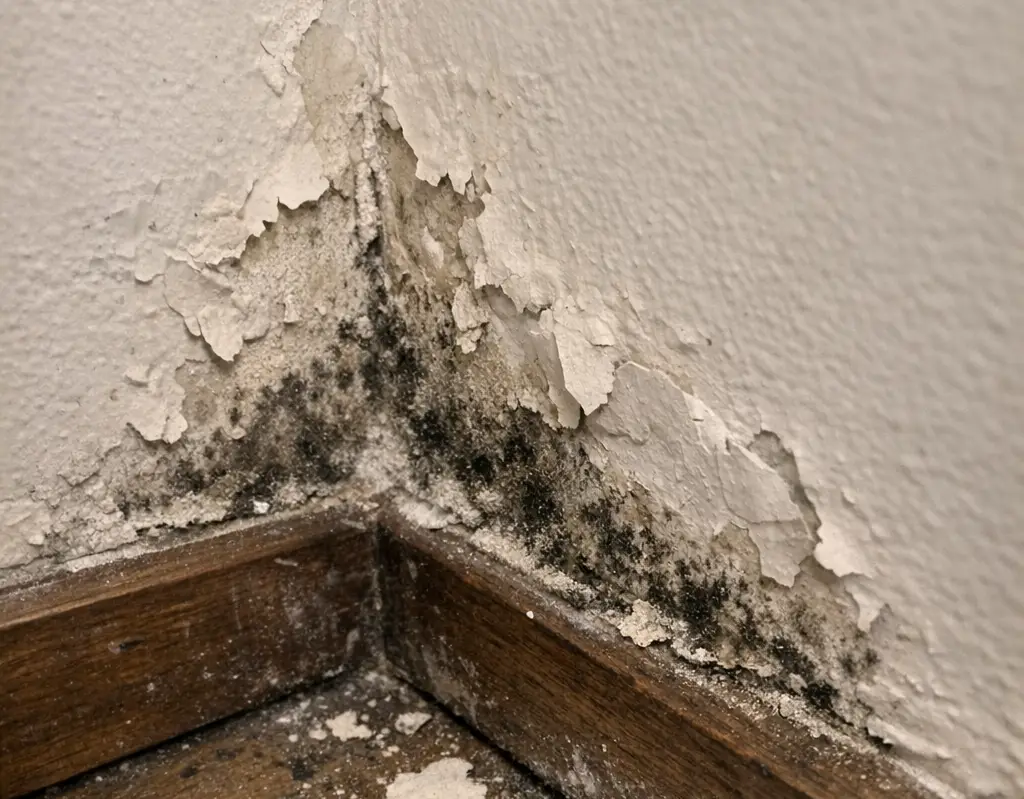
A ground-floor flat in Pâquis, a Tuesday in November. You pull the wardrobe aside, and the corner of the wall appears: a few black spots near the floor, the paint swelling slightly above the skirting board. The question comes, almost under one’s breath: “We can just paint over it, right?”
We understand that urge to get it over with quickly. Only, covering a stain does not erase it: it tucks it under a coat of white, for a few months, until it works its way back up. Here is how we read a wall like this before reaching for the roller — without dramatising, but without kidding ourselves either.
Can you paint over a damp wall?
The answer fits in a few words: on a still-damp wall, painting is pointless. Paint does not dry anything, it does not plug a leak, it does not warm up a cold corner. Laid over a substrate soaked with water, it eventually swells, peels off in patches, and the stain bleeds back through the fresh coat within a few weeks.
A comparison we often use on site: it is like putting a plaster over a wound you have not cleaned. It hides, it does not heal.
Manufacturers’ data sheets all ask for the same thing: a clean, dry and well-adhering substrate. The word “dry” is worth pausing on, because a wall can feel dry under the hand and still be full of water deeper down. There is, in fact, no official Swiss public figure for wall moisture “before painting” to recite: the standards that apply are technical and paid-for. So the trade reflex is simple — when in doubt, measure the residual moisture with a meter, do not judge by eye.
The rest follows from that. You find where the water comes from, you remove it, you let it dry. The paint comes afterwards, never before.
Can you paint over mould?
This is the most common version of the question, and here the answer is even clearer. No, you do not paint over mould — and this is not just a tradesman’s opinion. The Swiss Federal Office of Public Health says so in black and white.
According to the FOPH, mould cannot be removed with a roller, and even so-called “anti-mould” paints are not a solution: they may slow the return for a while, but the problem comes back as long as the source of damp remains. So the order to follow is always the same — first the cause, then the complete removal of the mould, and only afterwards the paint.
That leaves the practical question: what can you do yourself, and from what point should you call someone? The FOPH’s reference brochure gives some size markers.
- A small surface trace, of the order of ten centimetres by ten in a single spot, can be cleaned simply, with water and a household cleaner.
- Beyond that, remediation is still possible, but it falls in principle to the landlord rather than the tenant.
- And as soon as it is extensive, settled deep down, present in several places or accompanied by a clear musty smell, it is better to leave the work to a professional.
In every case, the FOPH insists on one point: the cause of the damp must be found and removed. Repainting without that already schedules the stain’s return. Knowing where it comes from — condensation, thermal bridge, rising damp, saltpetre — deserves its own diagnosis, which we cover in our article on mould, damp and saltpetre on walls.
Is wall mould dangerous to health?
The question comes up often, and it is legitimate. Mould in a home is not just a matter of appearance: it can irritate the airways, especially for people who are asthmatic, allergic or more fragile. That is no reason to panic, but one more reason not to settle for covering it up. If you are worried about your health, the best thing is to speak to a doctor.
Prevention rests on one factor you control at home: the humidity of the air. The FOPH advises keeping indoor relative humidity at around 30 to 50% (and rather below 40% on very cold days), and airing in bursts — windows wide open for five to ten minutes, several times a day — rather than leaving a sash ajar all the time. In Geneva’s older buildings, often poorly insulated, air that is too humid quickly encourages condensation in cold corners.
A word on a myth that goes around a lot: vinegar. You read it everywhere as a miracle cure for mould, yet the FOPH advises against it. On limestone-based substrates, the acid is neutralised, and the sugars it contains can even feed the fungi. To disinfect a small surface, once cleaned, the FOPH cites bleach or alcohol at 70-80% instead. But no product replaces the only thing that really matters: as long as the cause remains, it comes back.
Can your wall be painted? Four checks in two minutes
- The touch. Hand held flat for a while: is the wall cool, a little clammy? A sound wall is dry and at room temperature.
- The blisters. Press gently: does it bubble, does it sound hollow? Water is trapped under the paint.
- The stains. Black or green spots in a corner, a yellow ring, a white powdery deposit low on the wall? Each has its cause, to be dealt with first.
- The smell. A hint of mustiness, a cellar-like smell? That is the sign of active damp, even when nothing shows.
A single “yes” and the conclusion is the same: do not paint yet.
Which paint for a damp wall?
On search engines, people type “waterproofing paint”, “pliolite paint”, “lime paint” for a damp wall, hoping for the product that will fix everything. Let us be frank: the answer always begins with the same sentence. No paint replaces treating the cause.
Once — and only once — the cause is removed and the wall is genuinely dry, the choice of finish makes sense. The principle is common sense: prefer a paint that lets the wall breathe over a very closed film, which would risk re-trapping any remaining damp. A film that is too sealed over a substrate still “working” is precisely what makes paint blister again a few months later. That finish goes with a primer suited to what is in front of you.
As for additives and “anti-mould” paints, they have a real but limited use. In a structurally exposed room — a poorly ventilated bathroom, for instance — they can slow a return, provided they are applied to a wall that is already cleaned and dry. Never as a replacement for the treatment. For the special case of wet rooms, where the product really matters, we explain it in our guide to anti-damp bathroom paint.
Paint blistering from damp: the rental case
This is the situation that causes the most friction, on both sides of the lease. Paint blistering from damp, in a rented flat: whose job is it? The answer deserves to be put calmly, because it serves the tenant as much as the property manager.
The first move costs nothing and changes everything: notify the property manager or landlord without delay, in writing, with photos. The tenant is obliged to report a defect they cannot repair themselves (Art. 257g CO), and reporting early stops the damage spreading — which could otherwise be held against them. A written record, here, protects everyone.
Then, each to their role, in broad terms. The tenant cleans the small surface traces, no more. Keeping the home in good order is part of the landlord’s obligations (Art. 256 CO): finding the cause and remediating a larger surface fall to them in principle. When the damp comes from a defect in the building — a thermal bridge, a pipe, an infiltration — restoring the paintwork is generally the landlord’s business. And if water damage is involved, it all goes through the insurers, a point we detail in paint and water damage: the steps.
Each situation is nonetheless assessed case by case, in connection with the lease. The table below gives markers, not verdicts:
| What you see on the wall | Can you paint over it? | What you do first |
|---|---|---|
| Wall cool or damp to the touch | No | Find the cause, dry it out, measure |
| Small black spots (about 10 × 10 cm) | No | Clean the trace, treat the cause |
| Extensive mould, musty smell | No | Remediation by a professional |
| Paint blistering, sounds hollow | No | Scrape, locate the trapped damp |
| Ring after water damage | No | Plug it, let it dry right through |
| Dry wall, cause removed, sound base | Yes | Suitable primer, then finish |
Read this with your lease and your check-in inventory in front of you: when in doubt, a look on site beats a table.
After water damage: patience before the brush
Water damage deserves a line of its own, because it is the most deceptive case. The leak plugged, the surface wiped, the wall looks dry within a few days. It is not.
Drying a wall deep down — the screed, the insulation, the partition — takes time. The Swiss portal hausinfo indicates that, as a rule, this drying takes two to five weeks, depending on the amount of water, the materials and the season. A “dry on the surface” substrate repainted too soon, and it is blisters and mould that come back shortly after. That is also why, on a site after a claim, the painter comes last: not out of slowness, but because painting before full drying means doing the work twice.
The mistake we come across most often, that one: repainting a stained corner “just before the check-out inspection” or “for Sunday’s viewing”, on a wall dried for three days with a fan heater. The paint holds a week, the stain bleeds back, the coat blisters — and it all has to be redone, this time by scraping. The time you think you save by skipping the treatment, you always pay back, and often double.
In practice: the cause first, the paint after
It all comes down to that order. A damp or mouldy wall is not a paint problem, it is a damp problem that ends in paint. You find where the water comes from, you remove it, you clean off, you let it dry properly. And then, only then, you repaint over a clean, dry base, with the right primer and the right number of coats.
It is less satisfying in the moment than covering it up fast. But it is the only way to have a wall that stays clean beyond the following autumn. When damp settles in fast — water damage, a stain that spreads — a quick look beats a gamble: our fast-response service in Geneva exists for those moments, and for restoration after a claim once the substrate is ready to take the paint.
The Renovhome team — Renovhome SA, Geneva A wall worrying you before you paint? The safest option is still a look on site: request a free quote, with no obligation.
Frequently asked questions
Key takeaways, in brief.
Can you paint over a damp wall?
As a rule, no. Paint does not dry the wall and does not stop the damp. On a still-damp substrate, it tends to blister, to peel and to let the stain reappear. Manufacturers' data sheets ask for a clean, dry, well-adhering substrate. The right order is to find where the damp comes from, remove it, let the wall dry, then paint. When in doubt about the drying, it is better to have the residual moisture measured than to rely on touch.
Can you paint over mould?
No, not directly. The Swiss Federal Office of Public Health is clear on this: destroying mould and then repainting is not enough, and even anti-mould paints do not solve the problem while the source of damp is there. You must first remove that cause, completely clean off the mould and let it dry, before any painting. A coat passed over still-active mould merely hides it for a few months.
Which paint should you use on a damp wall?
No paint replaces treating the cause: that is the starting point. Once the cause is removed and the wall is dry, prefer a finish that lets the wall breathe over a very closed film that could re-trap the damp, with a primer suited to the substrate. Additives or so-called anti-mould paints can help in some exposed rooms, but only on a cleaned, dry wall — never as a repair on their own.
Is wall mould dangerous to health?
Mould in a home should be taken seriously: it can irritate the airways, especially for people who are asthmatic, allergic or in fragile health. If you are worried about your health, it is best to ask a doctor. To limit the risk, the FOPH advises keeping indoor air humidity at around 30 to 50% and airing wide open several times a day. A small surface trace can be cleaned yourself; beyond that, or with a marked musty smell, remediation is for a professional.
Should you treat mould with vinegar or bleach?
The FOPH advises against vinegar: on limestone-based materials, the acid is neutralised and its nutrients can even encourage regrowth. To disinfect a small surface after cleaning it, the FOPH cites bleach or ethyl alcohol at 70-80% instead. But disinfecting is not enough if the cause of the damp remains: without treating it, the mould eventually comes back.
In a rental, who has to deal with a wall that goes mouldy?
The tenant's first move is to notify the property manager or landlord without delay, in writing and with photos (Art. 257g CO). The tenant cleans small surface traces themselves; finding the cause and remediating larger areas fall in principle to the landlord, who is required to maintain the home (Art. 256 CO). Each situation is assessed case by case, in connection with the lease. Reporting early and in writing protects both sides and lets the problem be dealt with before it worsens.
Guide published by Renovhome SA, painting company in Geneva — interior painting, ceilings, enamel finishes and between-tenancy repaints in every commune of the canton. One dedicated contact — ask your painter in Geneva for a free quote.
Your project
Describe your project, receive your free quote.
A few lines are enough to get started. We call you back quickly, then you receive your free quote. A dedicated point of contact who follows your project, from measurements to handover.
Rated 5,0 out of 5 · 20 Google reviews · A free, written, detailed quote. Quick reply. Your data protected (Swiss Data Protection Act).